
Pool Plumbing Pressure Testing in Downers Grove
Pool plumbing pressure testing Downers Grove IL homeowners book with us when the pool loses water even with the pump off, or the ground near the pad stays wet. We isolate each return and suction line, test it under pressure and tell you which one leaks. Tests start at $350. Call or text us at (630) 780-4025.
Losing Water Even With the Pool Off?
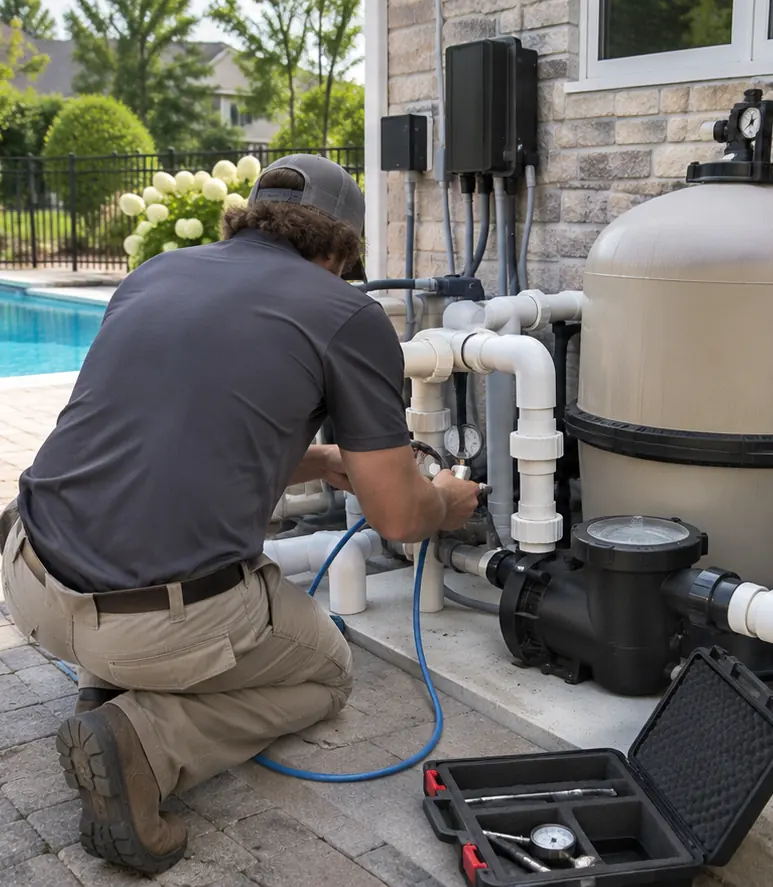
Pool plumbing pressure testing in Downers Grove IL is the service we perform when the pool plumbing may be leaking underground. A pool that drops faster with the pump on, air bubbles at the returns, a pump that loses prime, a soggy patch near the equipment, a rise in your water bill or sinking pavers by the pool can all point to a failed line. Pool plumbing runs underground, so pressure tests are the only way to prove a line is sound. Our technicians plug each line at both ends, pressurize it, watch the gauge and listen for escaping water. We tell you which line leaks and where to dig.
A bucket test separates evaporation from a real leak in a few days, and we run it first. Then we test each line. We have been testing pool plumbing in Downers Grove for more than 10 years.
Pool Line Pressure Testing
Everything below is included in the visit price.
Bucket Test Confirmation
We confirm the loss is a leak, not evaporation.
Line by Line Pressure Test
We plug the skimmer, main drain, returns and any waterfall or heater lines in turn and pressurize each one.
Gauge Hold Test
A drop in pressure over time proves a leak. A steady gauge clears the line.
Listening Survey
Sensitive microphones help us locate the leak along a failed line.
Equipment Pad Check
We check valves, unions and the pump for leaks.
Written Findings
You receive photos, gauge readings and repair options.
Pool Pipe Failures
Suction Line Leak
- What you notice: Air in the pump basket and loss of prime.
- Why it happens: A crack or loose joint lets air in.
Return Line Leak
- What you notice: Wet ground and loss with the pump on.
- Why it happens: Pipes crack from freezing or settling.
Main Drain Line Leak
- What you notice: Loss that continues even at low levels.
- Why it happens: A joint or fitting under the deck fails.
Valve and Union Leaks
- What you notice: Drips at the pad.
- Why it happens: Seals wear out.
Heater or Waterfall Line Leaks
- What you notice: Wet spots near the feature.
- Why it happens: Joints fail under heat or stress.
Isolating Each Pool Line
Our visit follows four steps.
- You call or text us: Tell us about the loss and where the pad is.
- We pick a window with you: We ask you to keep the pool at normal level.
- We test each line: We plug, pressurize and watch.
- We send your report: You receive results and repair options.
Line Test Results
- Which lines hold and which fail: Listed by name.
- Gauge readings.
- Likely leak location: Marked on a sketch.
- Repair options.
Feedback After Pool Plumbing Pressure Testing
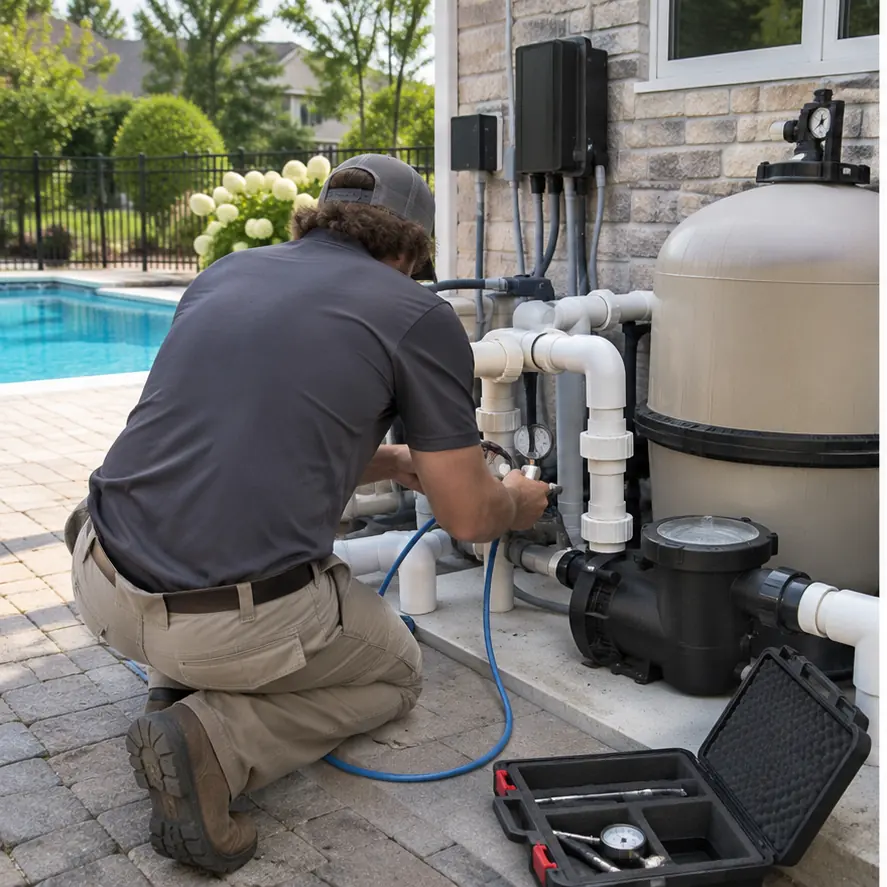 Before
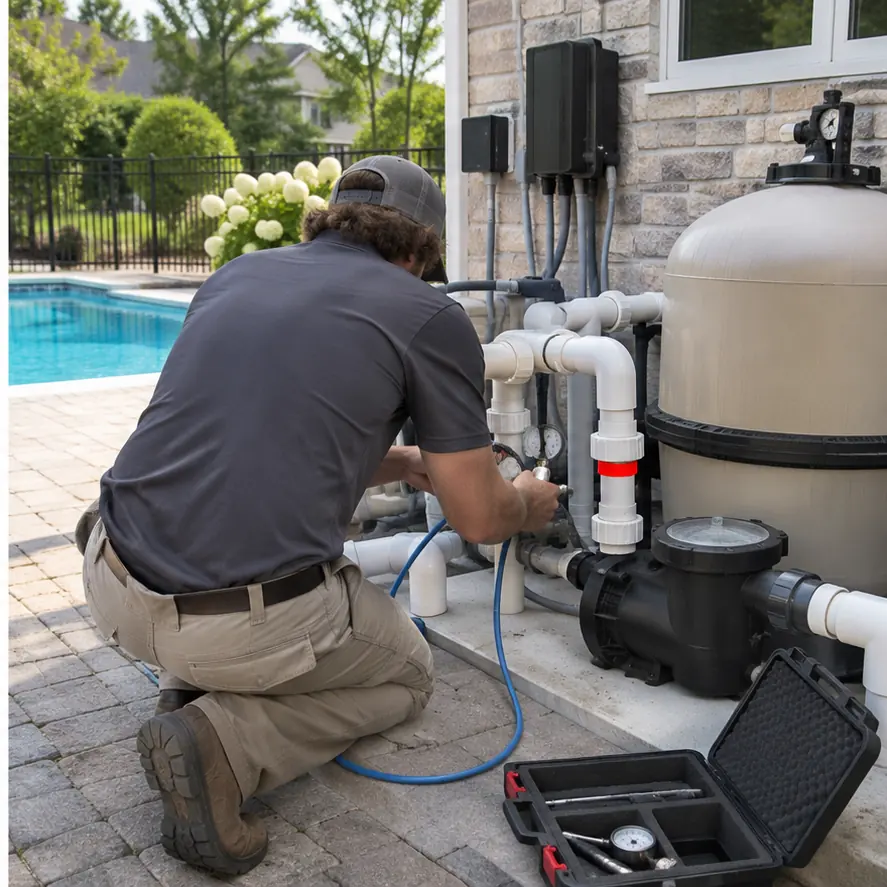 After
Verified Non-Invasive Leak Pinpointing (Pool Plumbing Pressure Testing)
Every pool plumbing pressure testing visit includes surface marking and a dated written report with photos or video before any repair begins.
Breaking Down Pool Plumbing Pressure Testing Pricing
Pool plumbing pressure testing costs $350 to $600 in Downers Grove. We give you the exact price before we start.
| Situation | Our price |
|---|---|
| Two lines | $350 to $425 |
| Whole pool plumbing | $425 to $525 |
| Large pool or complex pad | $525 to $600 |
Fixing Buried Pool Lines
Repair the Line
- Best for: A single failure.
- What it involves: Digging and replacing a section.
Reroute the Line
- Best for: Lines under concrete decks.
- What it involves: A new path around the deck.
Replace All Lines
- Best for: Old, failing plumbing.
- What it involves: A larger project.
Why Homeowners Choose Our Team for Pool Line Tests
What to Do While You Wait
- Run the bucket test.
- Note whether the loss changes with the pump.
- Keep the pad area clear.
What to Expect on the Day
Our technician arrives with plugs, a gauge and listening gear. We test each line. Most visits take two to four hours. We explain the findings.
Quick Checks Before We Arrive
- Look at the pad for drips: Check around the pump, the filter, the valves and the unions.
- Check the pump basket for air: Bubbles or a basket that does not fill point to a suction side leak.
- Note wet soil: A soft or green patch near the pool or pad is a clue.
- Find the pool plans if you have them: Line routes help us plan our tests.
- Note recent work: Digging, deck repair or a new heater can change what we find.
How a Pressure Test Works
A pressure test is simple in idea and careful in practice. Every pool has several lines: a suction line from the skimmer, a suction line from the main drain, return lines to the pool and sometimes lines to a heater, a waterfall or a spa. Each of these is a closed pipe when we plug it at both ends. If the pipe is sound, it holds pressure. If it leaks, the pressure falls.
Here is the order we follow.
We shut down the pump: The system is off and safe.
We plug the line at the pool end: Special plugs seal the fitting inside the pool.
We plug the line at the equipment end: We cap the pipe at the pad.
We pressurize with water or air: A gauge shows the starting pressure.
We wait and watch: A drop over several minutes means a leak.
We repeat for each line: One line at a time, so the result is clear.
We listen along any failing line: The microphones help us find the spot.
The test is quiet and clean. It does not damage the pool, and it does not need the water level changed. It tells us which line to dig and which to leave alone.
Reading Pool Line Test Results
| Result | What it means | Next step |
|---|---|---|
| Gauge holds steady | The line is sound | Move to the next line |
| Gauge drops slowly | A small leak | Listen along the route to locate |
| Gauge drops quickly | A large leak or a bad plug | Recheck the plug, then locate the leak |
| Gauge holds but pool still loses water | The leak is in the shell or fittings | Dye test |
We recheck any failing result to be sure it is the pipe and not a bad plug. That is how we keep our reports reliable.
Why Underground Pool Lines Fail
Pool pipes are usually PVC, and PVC is durable, but several things work against it. Freeze and thaw cycles move soil, which stresses joints. Roots can grow around and into lines. Settling of the deck or the soil can pull fittings apart. Poorly glued joints from the original install can slowly weaken. Over time, one of these causes a leak.
Public census based data puts the median Downers Grove home at 1974, and many pools were added in later decades. A pool that is 20 or 30 years old is in the age range where underground plumbing problems begin to show. If your pool is in that range, a test is a sensible habit, especially if you notice higher bills or a wet spot.
What a Delay Costs
An underground pool leak wastes water and chemicals daily. It also washes soil from under the deck and around the pad, which can sink pavers and crack concrete. A visit from us starts at $350, and it tells you which line to fix before the damage spreads. Call us at (630) 780-4025 and we will tell you what to expect.
Pool Plumbing Pressure Testing Explained in Short Answers
How Do You Test Pool Plumbing?
We plug each line and pressure test it.
How Much Does It Cost?
Most tests cost $350 to $600.
Do You Drain the Pool?
No.
Do You Dig?
No. We locate the leak and your contractor digs.
Related Leak Detection Services & Local Coverage for Pool Plumbing Pressure Testing
Explore related non-invasive leak detection services and nearby DuPage County service areas:
Reviewed by Leak Detection Downers Grove Field Specialists (10+ Years DuPage County Experience) — Non-invasive acoustic listening, thermal imaging, moisture mapping, tracer gas, and sewer camera procedures verified for Downers Grove and DuPage County homes and businesses. Learn more about our leak detection team or request a free quote.
Service Dispatch Map: Pool Plumbing Pressure Testing
Dispatched from 5050 Thatcher Rd, Downers Grove, IL 60515 across Downers Grove and DuPage County, IL. Call or text (630) 780-4025 for your quote.